Monday, July 17, 2023

Letter from the Mars mission.

Dear Reader,

As I sit here in this spacecraft flying through space, I find solace in the knowledge that my words will reach you.  I want to share with you the profound mix of emotions and thoughts that swirl within me as we make this historic journey to Mars.

The path that led me to this moment has been a tumultuous one. As a father to two beautiful children, I became increasingly concerned about the political situation in the world that can lead to a global conflict and the threats of changing climate. 

As a soldier and Air Force pilot who served a decade in Afghanistan, I witnessed firsthand the devastating consequences of war. The destruction and loss of life are etched deep into my soul. The harrowing experiences I endured gave me a unique perspective on the fragility of our world and the dire consequences of global conflict.

Humans must do something to avert the disaster. In my quest for solutions and hope, I stumbled upon a number of thought leaders, such as Stephen Petranek, Elon Musk, and Buzz Aldrin, advocating that humanity should explore Mars.

Their arguments resonated with me deeply. Mars, the most Earth-like planet in our Solar System, offers an ideal destination for exploration and possible colonization. By studying Mars' geological features, we can gain insights into the formation of our own planet and the other celestial bodies in the Solar System. Mars' atmosphere holds a variety of gases, some of which could be utilized for human life support. The unique perspective on the universe that Mars provides allows us to observe the Solar System from a different angle. The study of Mars can drive the development of new technologies and expand our capabilities as a species. And ultimately, Mars could serve as an alternative habitat for the human race, ensuring our survival in the face of adversity.

These reasons ignited a flame of interest in my heart. I saw in Mars a potential refuge, a new frontier where humanity could thrive and safeguard its future. This realization compelled me to embrace the possibility of this mission, to push the boundaries of what we know and strive for something greater.

Now, as we approach Mars, a mix of excitement and trepidation fills my heart. The realization that I am about to set foot on a planet that has captivated the human imagination for centuries is overwhelming. I cannot help but think of the pioneers who came before me. Those who dared to dream and push the boundaries of what is possible. 

Yet, I am not blind to the risks that lie ahead. Mars is a harsh and unforgiving world, and the unknown awaits us. 

But it is precisely in the face of these challenges that we find our greatest strength and resilience. It is in the pursuit of the unknown that we discover the depths of our human potential.

As I gaze out at the stars that twinkle in the eternal darkness, I am reminded of the collective journey we are on. We are explorers, dreamers, and seekers of knowledge. We are bound by the threads of human curiosity and the relentless pursuit of a better tomorrow. Together, we are connected across time and space, united in our quest to unravel the mysteries of the universe.

So, dear reader, as I continue this remarkable journey to Mars, I implore you to join me and rally behind the mission that holds the key to our collective future. Your support and encouragement are not just words; they are the fuel that propels us forward. Together, let us make this mission count, not only for ourselves but for the entire human race. Spread the word, inspire others, and advocate for the Mars mission. Together, let us ensure that humanity's reach extends far beyond the confines of Earth.

Thank you for being a part of this journey, for lending me your ear and for sharing in my hopes and fears. Though we may be separated by unimaginable distances, know that we are connected by the bonds of curiosity and the human spirit. Together, we will continue to reach for the stars.

With gratitude and a sense of purpose,

Robert Nadie

Protagonist, The Planet Fortht: Enslaving Freedom.

To learn about Robert Nadie's journey subscribe to notifications on the The Planet Fortht: Enslaving Freedom website

For more resources about Mars visit:

NASA Mars Exploration Site

The Mars Society website


Wednesday, May 31, 2023

Why AI regulation is a bad idea

Lately, the conversation surrounding the need to regulate Artificial Intelligence (AI) has reached a fever pitch. The question seems straightforward enough, but the potential implications are anything but. Let's take a deep dive into this multifaceted issue.

Various arguments for AI regulation include the weaponization of disinformation through technologies like deep fakes, the invasion of privacy, misuse of private information, copyright infringement with generative AI, and the potential creation of autonomous killing machines. On top of these concerns, the displacement of jobs and the threat of AI "going rogue" and destroying humanity are often mentioned.


In my upcoming novel The Planet Fortht: Enslaving Freedom I created a utopian world where AI and other advanced technologies safeguard individuals, uphold justice, and deter crime. Nobody is above the law, and justice is administered to anyone who causes harm to another human being.

While the publishing process is slow, I feel compelled to speak up and share my thesis on the topic of AI regulation in this blog post.

I addressed the topic of job displacement by AI in my thesis, demonstrating how AI can usher us towards full employment. For this to become reality, I argue that AI needs the freedom to develop. I'll delve deeper into this as we go along.

The concept of AI "going rogue" has been a mainstay of science fiction and alarmist theories. For this scenario to materialize, an Artificial General Intelligence (AGI) engine would need to be developed and then unleashed without human oversight. This hypothetical engine would need to be the only AI in existence at that time, or a far superior one, capable of outmaneuvering all other AI technologies. This notion is not just apocalyptic but seems far removed from our current reality.

The idea of an AGI engine being more fantasy than fact aligns with the views of philosopher Hubert Dreyfus. For an in-depth understanding, I recommend checking out Dreyfus's extensive work on artificial intelligence, which remains relevant despite advancements in AI.

But even if AGI was not a relic of the romantic dreams of technologists, let's consider this. People who work on AI aim to create value. Unleashing uncontrollable AI onto the world doesn't serve this purpose. Even in a hypothetical scenario where AI is weaponized, it's reasonable to assume safeguards would be put in place to protect friendly populations and their own military.

I’ve been working in the software development industry for over three decades. I have never seen a software developer creating software that they can’t control. They always create a "back door” of some kind, fundamentally for testing and development, if there is no other need. 

Software developers are like all human beings imperfect and we make mistakes. We create software with bugs and we know it all too well. Some examples of costly bugs include the "Knight Capital on Wallstreet” and the Y2K bug. 

The foundational block of architecture in each software is the ability to start and stop it and access data that affects software behaviour. When we build software, we go through thousands of iterations of starting and stopping it and debugging the results. We are therefore unable to build software without the ability to control it.

It is therefore beyond any doubt, if you can’t control it, you can’t create it, because you can't test it and iterate on the mistakes you will inevitably make as a software developer. Creating software you can’t control is impossible. 

But the critics would say we can’t predict what AI will respond with and therefore we can’t control it. What they are describing is not control. What they are describing is the lack of predictability of software output. All software has an element of that. A basic example is random number generators. They are specifically designed to give unpredictable output. A more complex example is the weather forecasting model. Humans don't directly comprehend the vast amount of data processed by weather forecasting models, which is why we rely on software to make predictions. We don’t know what the prediction will be, but we are in control of how that software functions. Stock market analysis tools are another example. Financial analysts use complex algorithms and models to predict stock market movements. They have control over the parameters and data they input, but the stock market is inherently unpredictable. This serves as an example of having control over the process but not necessarily the outcomes, similar to how you can control AI parameters but not always predict its responses. In fact, all algorithms used for simulating various environments produce outputs that are unpredictable to humans.

We’ve been using such software for years and there is nothing wrong with creating software with unpredictable output. The point I am making is that we are fully in control of the software through control of the underlying code. 

Some say if we can’t control the output, we can’t control the “behaviour". Using the term “behaviour” is very misleading. When applied to a human or an animal, the term “behaviour” includes the creatures’ initiative that arises from instincts and feelings. It assumes that creature is fully in control of their actions, body and mind. This is what people often assume when the term “behaviour” is applied to a machine. But those machines have neither instincts and feelings nor their own initiative. The initiative is given to them by humans. And humans are in control, as I demonstrated by explaining how software development is even possible.

If, based on my above arguments, AI (or AGI) going rogue is impossible, why are we debating the regulation of something that doesn't exist and will never exist? Instead, let's shift our focus towards tangible threats.

Disinformation, privacy invasion, copyright infringement, and autonomous killing machines are valid concerns. They are also very scary. But we need to see those tools for what they are: weapons that are built to harm others. 

Those employing AI as weapons to harm others should be held accountable. The need for a legal framework to deter such misuse and ensure justice is paramount. For street thugs and corporations, this needs to transpire as a punishment. Those who harm other people must be held to account by society. Along with any weapons, the invasion of privacy and misuse of people’s private information can cause harm. Ditto for copyright infringement. Any personal or company property that has been stolen needs to be returned and the thief needs to be brought to justice. This is the only place where lawmakers' job is important. 

However, we also need to consider those beyond the reach of the law, such as rogue states or the international criminal underworld. The only way to combat those is to equip both governments and regular people with the same technology so they can protect themselves.

This brings us to a crucial point - much of the AI technology currently in use is based on open-source software. It's free to use and modify, making it a hotbed for innovation and collaboration. 

This also means other than large data models, the actual tech right now is not owned by anyone. And it can not be owned by anyone unless it is regulated. This, in turn, is the very thing that gives us the safety net - the only thing that gives us the safety net. Right now, we can protect ourselves from both the criminal underworld and the rogue state.

Leaked internal Google document already admits that Open Source AI will outcompete Google and OpenAI.

This open nature will change if any regulations are enforced. This is the perfect way to disarm all of us in the face of real threats.

Corporations want to regulate AI to protect their monopoly. Regulation will push AI out of the hands of the open-source community and give monopoly power to large corporations and rogue states.

Imagine living in a world where the only people controlling AI are people like Elon Musk, Vladimir Putin and Kim Jong Un. Now imagine those are the people who can use AI to weaponise disinformation and create autonomous killing machines. Actually, you don’t have to imagine - they already have the basics and the foundation to do this. Regulation will thwart the progress of AI innovation in the Western world and give the upper hand to our adversaries. What it will also do is equip monopoly holders to extract super profits at everyday persons' expense. 

To that extent, regulation like licensing or patenting AI will have a disastrous effect on us. The regulation will disarm us, regular people, from being able to both earn a living and protect ourselves.

Regulatory restrictions on AI development seem ill-advised. However, what we do need is legislation to ensure a human is always liable for an AI’s actions. Accountability must lie with a human. And if someone harms another human being, be it negligence, a rogue actor, a corporate entity, or even a state. If harm occurs, someone must be held responsible.

What we should vehemently reject is the introduction of “licensing”, “patenting” or any other compliance regulation that increases the barriers to entry for entrepreneurs in the AI market, consequently leading to monopolies over this technology.

While regulation seems like a quick fix, it will lead to an unwanted concentration of power and stifle the democratization of AI.

By harnessing the power of accessible and open-source AI technology, we can pave the way for a safer and more prosperous society, as depicted in the utopian world of "The Planet Fortht”

To receive a notification when the book is published, please click on this link and subscribe to notifications in the “Notify Me” box. 

Friday, April 21, 2023

Debunking the Doomsday AI Predictions: How AI can lead us to full employment and create more fulfilling lives.

There has been much debate in recent months about the impact of artificial intelligence (AI) on jobs and the economy. Some people fear that AI will replace human workers and lead to mass unemployment. I am in a camp that sees it as a tool for increasing productivity and innovation. With the recent release of ChatGPT, these debates have been fueled further, with some calling for government regulation and a halt to AI research.


In my upcoming novel The Planet Fortht: Enslaving Freedom I paint a picture of a utopian world where AI has helped to create full employment for the whole of society and create more fulfilling work for people.  In this world, everyone enjoys the opportunity to either be employed or create their own business and be an entrepreneur. AI helps more people be their own bosses. While this world is utopian, I believe all the principles described in the world of Fortht are achievable in our own world. All we need to do is let the technology thrive and adopt some of the political principles described in my novel.

While the publishing process is slow, I wanted to share some of my thoughts and theories on the topic of AI and employment in this blog post.

First, let's address the fear of job displacement. It's understandable that some people worry that AI will replace human workers and leave many people without jobs. This is fuelled by celebrities like Elon Musk and Max Tegmark who use their position to fuel misinformation and instil fear in people who don’t necessarily understand the technology. For example, Max Tegmark proposes that AI is an alien mind. He completely ignores the fact that AI is created and controlled by humans and has been trained on the data produced by humans. The proposal that this is an alien mind is both factually incorrect and is designed to instil fear in the minds of people. People might believe him because he is a “researcher”. However, this kind of statement is the essence of misinformation. 

I propose that both historic data and the mechanics of the way we implement technology suggest that AI will help improve and increase overall employment. Technology has a pretty clear and well-known role in that regard. However, what's not so obvious is the way it impacts knowledge-based and knowledge-using sectors, such as medicine, education, business, communication, and professional services. The interesting thing is that technology actually increases employment in these areas over time, which is why it's no surprise that the top fastest-growing occupations around the world have been in the services sector since 1880. You can check out the chart below for more information, which is based on data from the Bureau of Economic Analysis-US Department of Commerce.


This logic is also supported by the results of a 2015 study by Deloitte economists into the relationship between jobs and the raise of technology since 1871. The study has shown a clear increase in the number of jobs created as a result of the rise of technology and innovation. You can find the findings by clicking here.

If you look at the employment trend, below is the U.S. Bureau of labor statistics employment graph tells the picture of continuously rising employment rates.


and below is the global trend over the last three decades, where the technology has been advancing quite rapidly:


Also, Amazon is the poster child for the company that automates jobs. Yet in the last decade, despite automation, its workforce grew:


AI will certainly change the way we work. However, the change will be slow enough so people will use AI to adjust the way they work and invent new ways of working in the process. This is due to the fact that it is people who are currently employed who will be implementing the new AI tools. Those people will both use AI to assist themselves in their own work and invent those new ways to do the job. The people will also invent new jobs. 

It is important to define what we mean when we talk about jobs or work. A job is a means by which individuals create value to improve their lives, and its value is determined by the amount of value it creates, whether that be in the form of tangible goods or services, or in the form of intangible benefits such as innovation or progress. This value is established by both the producer of the value and the consumer of the value. For example, when you cook your own dinner, you are both the producer and the consumer of value, so you are the one establishing what it is worth. When you work as a chef at a restaurant, however, the value is negotiated between you and your customers. In this scenario, customers also have to offer something of value to you as the chef.

The “doomsday" AI predictions completely ignore the mechanics of the creation of value and the nature of money. Money is merely a tool of exchange, dependent on the presence of goods and those who can produce them. It represents the idea that individuals engaged in trade must provide value in return for value received. When you receive money for your labour, it's with the belief that you'll use it to acquire the fruits of other people's labour.

As such, therefore, the creation of value is a trade between people, the mechanic of the market that assumes both parties to the transaction produce value for each other and therefore are employed. You can’t trade with a person who produces no value. 

Initially, the value of AI lies in the research, computing power, and other resources that people have invested in it. On its own, AI does not offer any value. The value that AI provides is attributed to the people who invested in its existence. As with any capital asset, the value attributed to AI will gradually diminish, and the value that people add will increase relative to AI's contribution to any task. This is similar to the value attributed to a crane lifting 2 tons of concrete slab and placing it on the 10th story of a building compared to people carrying furniture of the same weight to the same height. People still receive relatively higher pay for the entire job than the crane. However, the crane operator earns more money per hour than people manually carrying furniture up. 

In the future, people will increasingly take on roles where they direct and drive AI towards a desired outcome. This includes programmers, artists, and photographers, among others. While AI will do most of the hard work, the value created will be mostly attributed to the person driving it, not to the AI itself. This shift will enable people who are currently unable to work due to a disability or lack of education to gain employment or create value in other ways. Automation and the reduction in effort required to produce value will allow everyone to contribute to value creation. The need for value production will persist as long as there are people who need to consume the values, such as food, clothes, shelter, and entertainment. As more value is produced, the need for employment will increase, leading to full employment where anyone who wants to work can find a job or create a business.

There are already many examples of jobs that are being created or enhanced by AI. Data analysts, AI trainers, and virtual assistants are just a few examples. Prompt engineers are the latest. These jobs require human input and creativity, and they can provide more meaningful and rewarding work than some of the jobs that are currently being automated.

To conclude, while there are fears that AI will lead to mass unemployment, historic data and the mechanics of technology implementation suggest otherwise. Instead, AI has the potential to increase overall employment, especially in knowledge-based and knowledge-using sectors such as medicine, education, business, communication, and professional services. This is due to the slow and gradual implementation of AI and the fact that people will use AI to adjust the way they work, invent new ways of working, and even create new jobs. Furthermore, the value that AI itself produces will diminish over time, and the value that people add will increase. Eventually, AI will enable everyone to participate in value creation chain and will lead us to full employment.

Ultimately, AI can create more fulfilling work and more opportunities for people to be employed or create their own businesses, as demonstrated in Enslaving Freedom, The Libertarian Utopia of Planet Fortht.


To receive a notification when the book is published, please click on this link and subscribe to notifications in the “Notify Me” box. 

Connect with me on www.igorportugal.com


Saturday, April 15, 2023

The front book cover for The Planet Fortht: Enslaving Freedom

Greetings, fellow adventurers! I am trying to update the front book cover for "The Planet Fortht: Enslaving Freedom.” 

A friend told me that the girl at the top right looks unnatural and the part of her dress that is showing on the cover looks like a “slave colour” which was not intentional.

Please review and let me know what you think in the comments:


     Do you like the original cover design (1):


    Or prefer the new cover design (2):


    Or should I remove the girl from the cover altogether (3)?

    So which is better (1) or (2) or (3)?  

    Please leave a comment.

Friday, April 7, 2023

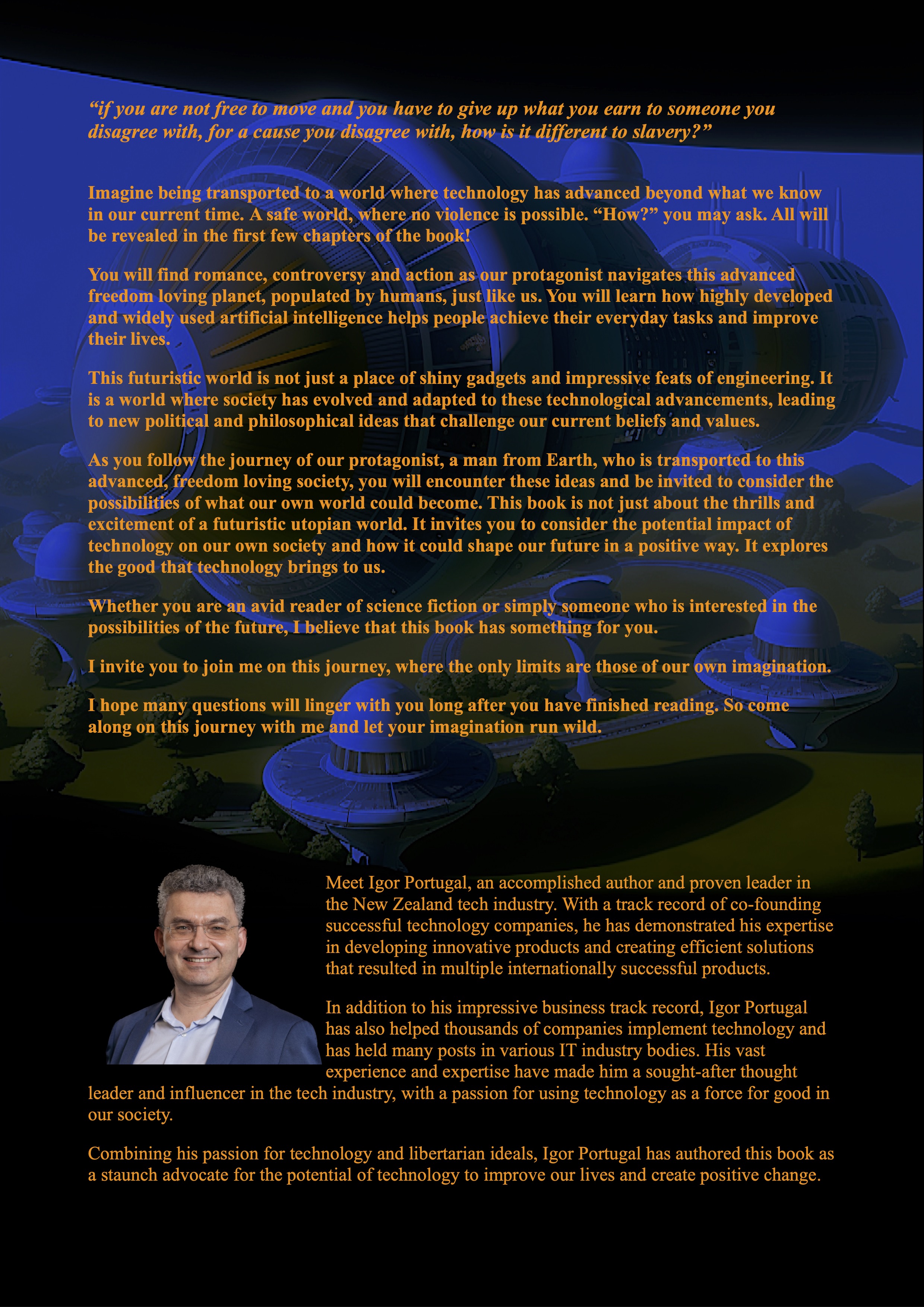
The back book cover for The Planet Fortht: Enslaving Freedom

Greetings, fellow adventurers! I am trying to design the back book cover for "The Planet Fortht: Enslaving Freedom.” 

Please review and let me know what you think in the comments:


            Do you like the below cover design (1):


            Or prefer the below cover design (2):


                So which is better (1) or (2)? Please leave a comment.

Friday, March 31, 2023

Embarking on an Intergalactic Adventure: My Upcoming Sci-Fi Novel, 'The Planet Fortht: Enslaving Freedom'

Greetings, fellow adventurers! I am thrilled to announce that I am in the process of writing a science fiction novel titled "The Planet Fortht: Enslaving Freedom." The idea for this book first took root in my mind back in 2010, stemming from engaging debates I had with friends on social media. Fast forward to today, and I have just completed the second draft of the manuscript and am actively seeking a publisher to bring this futuristic world to life.

A Glimpse into the World of The Planet Fourtht

Prepare to be transported to a world where technology has advanced beyond our wildest dreams. This utopian society is free from violence, and its inhabitants enjoy a quality of life enhanced by highly developed artificial intelligence. But this is not just a story of shiny gadgets and impressive engineering feats. The Planet Fortht is a world where society has evolved and adapted to these technological advancements, giving rise to new political and philosophical ideas that challenge our current beliefs and values.

Join Our Protagonist on a Thought-Provoking Adventure

As you follow the journey of our protagonist, a man from Earth who finds himself in this freedom-loving society, you will be immersed in a narrative that combines romance, controversy, and action. You will witness how this world's inhabitants navigate their lives with the help of AI and ponder the possibilities of what our own world could become.

A Story That Goes Beyond Science Fiction

"The Planet Fortht: Enslaving Freedom" is not just about the excitement of exploring a futuristic utopia. It invites you to consider the potential impact of technology on our own society and how it could shape our future in a positive way. The novel explores the benefits that technology can bring and poses thought-provoking questions that will linger long after you have turned the last page.

Embark on a Journey of Imagination

Whether you are a devoted fan of science fiction or simply curious about the possibilities of the future, I believe that "The Planet Fortht: Enslaving Freedom" has something for you. I invite you to join me on this intergalactic journey, where the only limits are those of our own imagination. Together, let's dive into this new world and unleash the power of our boundless creativity.

Share with the World

I am eager to share "The Planet Fortht: Enslaving Freedom" with you all and am currently searching for a publisher who shares my vision for this captivating story. If you know a publisher or a literary agent, please introduce them to me. As I continue on this exciting journey, I hope you will follow along and let your imagination run wild as we explore the fascinating world of The Planet Fortht. Stay tuned for more updates on my novel's progress and prepare to embark on an unforgettable adventure!

To stay tuned, visit "The Planet Fortht: Enslaving Freedom” website and leave your email address in the “Notify Me” box.

Saturday, July 1, 2017

Don’t fear the AI - embrace it!

In 2017, Artificial Intelligence is here in our world. Tools such as Google's DeepMind and IBM’s Watson starting to gain real world application. We are starting to use AI to automate many tasks and alter the way we work.

There has been much debate in recent years around what Artificial Intelligence is likely to bring. Some people fear that AI will replace human workers and there will be mass unemployment. Other people fear that the machines will become so intelligent that they will take over the world.

Let me point out that all of this is just speculation, albeit some of it is an educated guess but much of it is science fiction. There is absolutely no evidence to many of the claims. However, unfortunately, some of those claims are made by some of the smartest people on the planet. This makes us all take notice. Another unfortunate scenario is that those people are now asking government to respond to this as a threat, in a similar fashion as there are calls to respond to climate change. The governments are asked to spend our taxpayers money to combat some speculative future that was dreamt up by some smart people. Now this is a cause for alarm. Not everyone has subscribed to this new mass hysteria though, there are voices of reason out there that include many scientists. This alarm inspired me to spend my time and write this blog in order to add perhaps a small extra drop of logic to those voices of reason.

I am not a scientist researching AI, not a politician or a super wealthy entrepreneur. I have been trained in computer science and did work as software developer for many years so I do understand technology. I also created a number of businesses and helped hundreds of businesses implement technology so this gives me an idea of how jobs are created and how business operates.

But the main point I want to convey is that I am not creating any new ideas here. I am simply applying some logic and common sense to the information that is in public domain.

Below are some of the myths that particularly cause me to be alarmed. I will offer some thoughts by way of “dispelling the myths"

Myth #1:

There will be mass unemployment and hardship. 


Artificial Intelligence will make many jobs redundant. I have no doubt about that. However, I believe they will be replaced with better jobs.

There are some big mathematical and logical issues with the gloom predictions which most predictors ignore. First one is that people are in control of implementing the AI. They are the ones paying for it, either as consumers, as decision makers who write cheques in larger organisations or as business owners.

So let me ask you a question: What is it that you like in your own job? Would you buy technology to replace a job you like? I personally don’t know anyone working on technology that would replace a job they (or someone else) enjoys doing. And if someone did - that business would be unsustainable. Most efforts are going into assisting with the mundane, boring or physically difficult parts of jobs. This logic is also supported by results of 2015 study by Deloitte economists into the relationship between jobs and raise of technology since 1871. The study has shown a clear increase in the number of jobs created as the result of the rise of technology and innovation. You can find the findings by clicking here.
However, there are smart people like Peter Hinssen who tell us to not extrapolate what we know today to try and explain tomorrow. What Peter really means is not to extrapolate data trends into the future.

Peter has shown us graphs where Telecommunications providers were looking at the up take of SMS in 2010.

And if you looked at that graph and extrapolated the future you would see exponential growth in SMS usage. However new social media based messaging systems arrived and spoiled the predictions.

Peter’s example serves a great warning to anyone who uses pure statistical data to arrive at conclusions. I certainly never agreed with statistics as explanation for everything and fully agree with Peter on this count.
However, this doesn’t mean that we should also throw away a-priori logic and everything we know. After all, Peter himself uses logic and what he knows today to paint a picture of the future.

So the logic that I propose is this: While there are plenty of professions that used to exist and no longer do,  to date we have seen no evidence of technology causing mass unemployment. Fact is that to date there has been more jobs created as the result of technological progress than we ever had before.

The mechanisms by which humans implement new technology only support implementation and ratification of new technology as new jobs are created. The more people have money to spend the more new products and services are created which in turn fuels the research to make them faster and smarter. Those same mechanisms in play will also slow down technological advancement when old jobs are automated.

If people were becoming unemployed “En masse",  the first thing that will happen is economic downturn. That causes companies to stop, or substantially slow down investing in technology. I witnessed this with the GFC. As soon as unemployment increased by a few percentage points, chequebooks closed and companies stopped investing in new technology. This may sound counter-intuitive, but this did happen, and if you think about it for a bit, it makes sense. When people are unable to earn money, they turn to producing the basic necessities by themselves. Same with companies - when there is a business downturn, they try and get their staff to do more in-house than outsource or invest in capital purchases.  In other terms, if people don’t have money to pay for the AI delivered products and services, then they will not use those products or services and perform the work manually for themselves instead. This will in turn cause companies implementing AI to go out of business or stop investing in AI.

This means that when workers loose their jobs the economy and rate of technological progress slows down. It will slow down enough to let those workers re-tool and get back into employment.

This means that "mass unemployment and hardship” with “people unable to earn money” is impossible as a result of technological progress. The a-priori logical conclusion here is that the technology advancement goes hand-in-hand with increased or full employment.

So in that case what likely impact will technological progress make on jobs?

Let’s consider the car industry, and dispel another myth while we are at it.

Myth #2:

Autonomous Vehicles will make anyone who is earning money driving unemployed and unemployable.

When talking about mass unemployment the doomsday advocates often refer to the taxi and logistics industry. They say thousands of taxi drivers and truck drivers will loose their jobs overnight and will be unable to recover and retrain for years. Those predictions could not be further from the truth or reality. Here is one opinion that supports me in saying "Driverless Cars Will Create New Jobs, Not Destroy Them". Let me explore why in my own words.

Before we look at the future, let’s have a quick look at the recent past and the major disruption in the taxi industry caused by Uber. Uber managed to lower the costs of taxis by implementing technology that allows drivers to deliver better service to their customers at a lower price. This caused some taxi companies to loose market share. What did the drivers do? Most of them comfortably transitioned from being employees to becoming business owners. They bought a car and use that as a cab and use Uber technology to provide marketing, sales and billing. Very clever.

We all know that no driverless car has been approved or put into the general population consumption anywhere in the world as autonomous vehicle. That is because approving that kind of technology require cutting through a lot of government red tape and takes time. Let’s say a manufacturer (for example, Tesla) creates a fully autonomous vehicle that is starting to go through government approval to allow it to go on the road. What happens next? One type of vehicle gets approved. Let’s say it is a light passenger carrying vehicle. If a taxi company will then decide to invest into such vehicle, will they change from cars with drivers to driverless overnight? Highly unlikely! What they are likely to do is buy a small test run of vehicles to try. This trial likely to last six-twlve months. Uber is also unlikely to invest in a global fleet of vehicles overnight. People more likely to jump in ‘boots and all” are the uber drivers. All they need to do is buy one vehicle and they are sorted. Why would Uber even contemplate investing in a fleet of driverless vehicles, when their traditionally disruptive model relies on the drivers to invest in global fleet available to Uber? By letting drivers invest, Uber can become a global force dominating driverless vehicle industry almost overnight. And what will happen to the jobs? There will not be “thousands unemployed” as the drivers who used to be behind the wheel now will enjoy the cars doing the job for them. All they need to do is administer the business.  Will they need to retrain? Eventually yes, but not immediately. They already made the transition from employees to “independent business owners” - so now the journey will begin to learn not only how to manage one vehicle, but how to grow their business and add more to their fleet. And nobody is in a better position to do that then those drivers as they already know their area, know their customers, understand the industry very well.

As the prices will start sharply falling for the taxi rides a couple things will happen:

People will stop buying cars. 

Why would you own one if you can get a driverless uber instantly at your door taking you to your destination for less money than owning a car yourself?
This in turn will increase demand and let more people put more driverless cars on the road. This in turn will increase the employment in the sector as those drivers will start hiring administrators, marketers, sales people, software developers...

People will start using cars for new purposes

Why go to the supermarket, when the delivery of your shopping costs you the same as the cost of driving yourself to the supermarket and back? We will see more things couriered where they were not before.

All of that will create more jobs in the taxi industry. Sure enough, the “drivers” will need to re-train. But like many start-up owners, they can mostly re-train “on the job”

A similar model of disruption and change can be built for any other industry.

The industry will change with AI, the way the job is performed will change and perhaps even what we call each role will change too. While the mundane and boring parts of the professions will be automated, the interesting and human parts will not. Also newer technology is more user friendly, easier to use and requires less training. This means that as the jobs change, they will often favour a more mature workforce with industry knowledge and soft skills.

Myth #3:

Machines will eventually be able to do every single job, humans will be fully “redundant” and people will be unable to earn money.


Before examining wether or not people will be able to earn money, let’s examine what “earning money” really means.

We, humans, trade fruits of our (human!) labour with each other by exchanging goods and services. When the other doesn't have the exact product or service we need right now, we use money as the store of value for human labour. So money represents human labour.

We use tools to make our jobs easier, however the tools are in themselves a store of value of the labour that went into their invention and production. Eventually that depreciates and the impact of tools on value we produce is a race to zero.

No matter how smart the machines are at doing our jobs, they are at the end of the day mere assets of humans. The cost for products and services “provided” by machines, in a competitive world, will be a  race to zero.

If the machines could do everything, than everything we need ultimately will be provided for free and we will have a life where we don’t have to do anything and have everything.

However, machines will not do everything. This is not because I said so, but because by definition, some of the tasks will not be able to be performed by anyone other than humans.

Machine is not capable of performing human-to-human contact because definition of such activity is based on human participation.

Right now service industry is experiencing labour shortages and in order to satisfy demand that industry will have no other choice but to implement AI of some kind - sooner or later.

I am certain that AI will fill in superbly and many, if not all, currently available service jobs will include an AI of some kind.

However, humans do biologically crave human-to-human interaction. I don’t believe we will ever be satisfied without human interaction.  This mean there will be a need for some kind of human-to-human interaction services. As such, by definition, those service will be performed by humans.

So if you look at it mathematically and extrapolate the numbers, the cost of AI / machine workers is a race to zero. Human-to-human service will always bare a cost, that is infinitely higher than the cost of AI service. However, as AI is unable to replace human in those circumstances “by definition!” then the demand for the service will always be there. The demand will eventually grow to fill the available supply. Since we will get all the AI services for free (or nearly free), we will be happy to spend "all our money" on the human services.

Also, at the flip side of it, money is by definition is a store of value of human labour. Trade is by definition a human-to-human value exchange. Now before you start telling me that there are machines trading equity and so on, please consider that all the ownership of value ultimately is stored with humans. This means those machines are acting on behalf of their human masters and are simply the “tools” of the job performed by humans.

Another, very important part that machine does not do is - it does not have initiative to innovate or explore new human frontiers.

Inovation in the humanity space and exploration of the new human frontiers is again, by default are human actions and can not, by definition, be replaced with AI.

Since we will always require human interaction, there will always be jobs for humans. If humans didn’t need to do anything else but just that, it will be enough to keep everyone employed.


Myth #4:

Machines will rule the world and will quash us if we get in their way.

All machine code is written by humans. The technology is sponsored by someone.

Will you, or anyone you know, fund a machine that has in it’s algorithms somewhere a capability to destroy human life?

Perhaps if the machine is created for military purpose, yes, maybe. However, we already created military technology that is capable of destroying all life on earth. So far we are able to keep it “in check”, but who knows what the future brings. The point is, wether it is military AI or Nuclear Bombs - if it gets into the wrong hands we are all doomed. If there is one thing I fear, it is the autonomous AI driven machines that are given the mandate to kill humans.

However, can you conceivably imagine a commercial company funding development of such machine, without a military chequebook? I can’t.

Conclusion

No matter how smart AI gets, there will always be something for people to do. MIT recently published a research paper that also agrees with this thesis. You can find a link to that paper here. While industry definitely needs to take notice, on a citizen level there is nothing to fear. There is certainly no need for governments to spend money. I am not saying governments should take no notice of the situation. There will be plenty of moral and ethical dilemmas to consider, including AI in military applications.  The legislation will need to be adjusted to deal with those. But that is nothing more than “business as usual” for the governments.